استشارة المنتج
لن يتم نشر عنوان بريدك الإلكتروني. الحقول المطلوبة محددة *

 إنجليزي

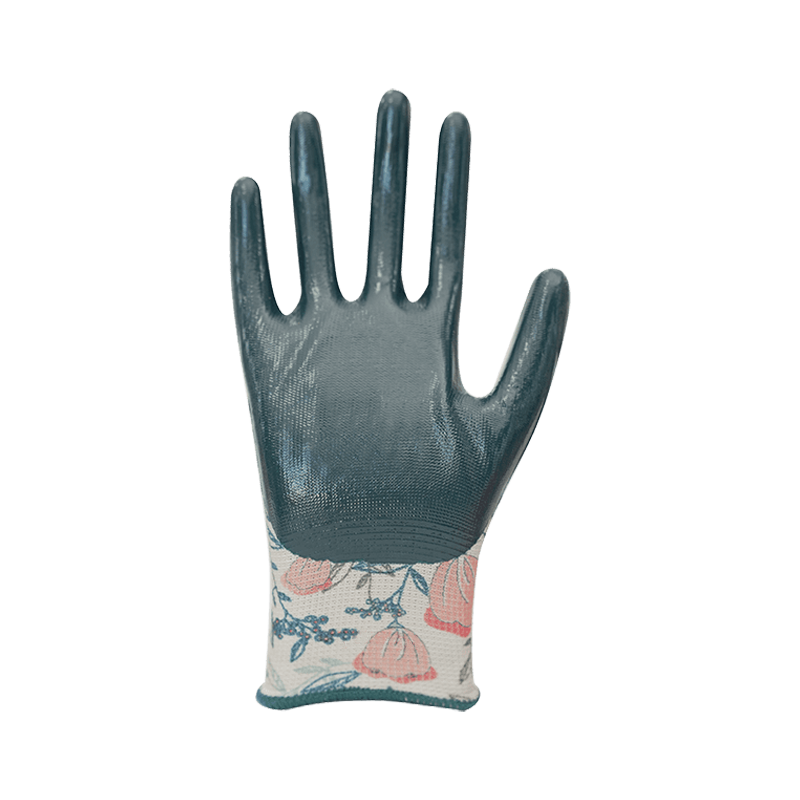
Nitrile gloves are widely used in medical, industrial, food service, and laboratory settings — and for good reason. They resist punctures, repel many chemicals, and work well for people with latex allergies. But they are not a universal solution. There are specific situations where nitrile gloves either fail to provide adequate protection, create new risks, or are simply the wrong tool for the job. Knowing when not to use nitrile gloves is just as important as knowing when to reach for them.
The short answer: avoid nitrile gloves when handling certain ketones, strong oxidizing acids, or highly concentrated solvents; when working with extreme heat or open flames; when fine tactile dexterity is critical and the task duration is short; or when the person wearing them has a documented nitrile sensitivity. Read on for the full breakdown.
Nitrile rubber performs well against oils, greases, fuels, and many diluted acids. However, its chemical resistance has well-documented limits that are frequently underestimated in workplace settings. The assumption that nitrile gloves protect against "most chemicals" has led to real exposure incidents in laboratory and industrial environments.
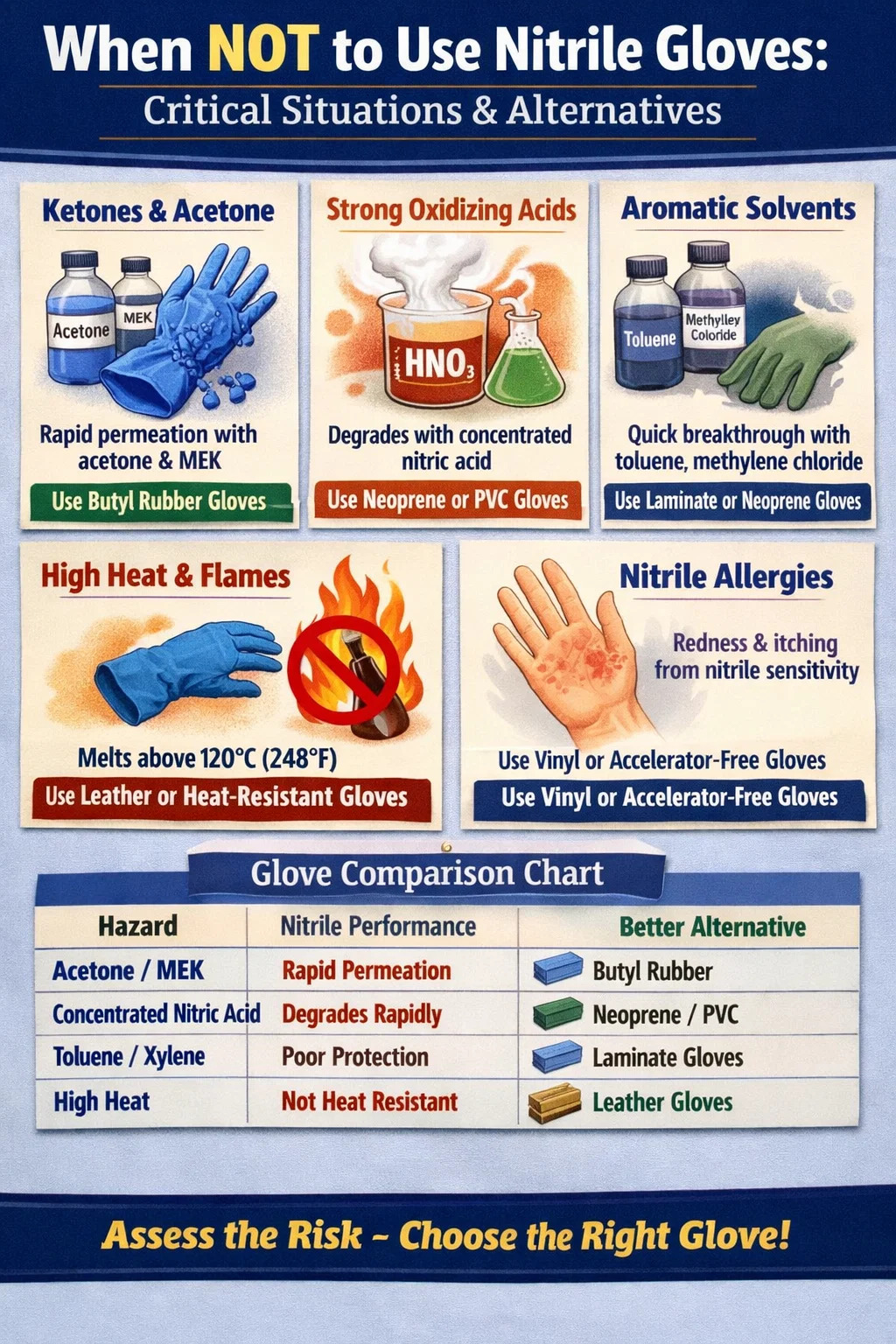
Acetone, methyl ethyl ketone (MEK), and other ketone-based solvents degrade nitrile gloves rapidly. Studies have shown that nitrile gloves can begin to swell and permeate within minutes of contact with acetone. The glove does not visibly tear — it absorbs the solvent and allows it to migrate through to the skin. This is particularly dangerous because the wearer often has no indication that exposure is occurring. For ketone work, butyl rubber gloves are the standard recommendation.
Concentrated nitric acid above approximately 30% and fuming sulfuric acid can rapidly degrade nitrile. At these concentrations, the oxidizing action attacks the nitrile polymer chains. Neoprene or thick laminate gloves rated for strong oxidizers should be used instead. Dilute acids at low concentrations are generally manageable with nitrile, but the distinction between dilute and concentrated is critical.
Toluene, xylene, methylene chloride, and chlorinated solvents like trichloroethylene show rapid breakthrough times through standard nitrile examination gloves. Breakthrough time — the time it takes for a chemical to pass through the glove material and reach the inner surface — can be under 10 minutes for thin nitrile gloves exposed to methylene chloride. Thicker nitrile (8–15 mil) performs better than thin examination gloves (3–5 mil), but even heavy nitrile is not recommended for prolonged aromatic solvent work. Laminated gloves or neoprene alternatives are preferred.
| Chemical | Nitrile Performance | Better Alternative |
|---|---|---|
| Acetone / MEK | Poor — rapid permeation | Butyl rubber |
| Toluene / Xylene | Poor to moderate | Neoprene or laminate |
| Concentrated nitric acid | Poor | Neoprene or PVC |
| Methylene chloride | Poor — fast breakthrough | Laminate gloves |
| Motor oil / grease | Excellent | Nitrile is appropriate |
| Dilute acids (under 20%) | Good | Nitrile is appropriate |
Nitrile rubber is not a heat-resistant material. Standard nitrile examination and industrial gloves begin to soften and lose structural integrity at temperatures above approximately 120°C (248°F). Near open flames or when handling objects above this threshold — such as in welding, foundry work, glassblowing, or cooking with high-heat equipment — nitrile gloves offer no meaningful protection and can melt onto the skin, making burns significantly worse.
For welding and metal fabrication, leather or aluminized gloves rated for the relevant temperature range are the appropriate choice. In food service, cotton or heat-resistant silicone mitts are used when handling hot pans and equipment. The distinction matters: nitrile gloves are appropriate in food prep for contamination control during cold and room-temperature handling, but they should not be worn when reaching into ovens or handling hot cookware.
Electricians and technicians working near live electrical components should also note that while some nitrile gloves offer limited electrical insulation, standard nitrile examination gloves are not rated for electrical work. Voltage-rated rubber insulating gloves with a specific ASTM class rating are required for live electrical tasks.
Nitrile gloves were widely adopted as a latex-free alternative, which solved a significant occupational health problem. However, nitrile is not entirely free of sensitization risk. A subset of users develops Type IV delayed hypersensitivity reactions to accelerator chemicals used during nitrile glove manufacturing — most commonly thiurams and carbamates, which act as vulcanization accelerators.
Symptoms of nitrile glove contact dermatitis typically appear 12 to 48 hours after exposure and include redness, itching, dryness, and sometimes blistering on the hands and wrists. Unlike latex allergy (which can involve immediate systemic reactions including anaphylaxis), nitrile sensitivity is localized and delayed — but persistent use without addressing the cause can lead to chronic dermatitis.
If a worker or healthcare professional develops skin symptoms while using nitrile gloves, the correct step is patch testing to identify the specific sensitizer. Accelerator-free nitrile gloves are available and eliminate most of the contact sensitization risk. Vinyl, neoprene, or polychloroprene gloves are also options depending on the task requirements.
It is worth noting that powdered nitrile gloves carry additional irritation risk, particularly in healthcare settings. Cornstarch powder used as a donning lubricant can carry proteins and chemical residues that aggravate skin and respiratory tracts. Most hospitals and clinical environments have moved away from powdered gloves entirely, and the FDA banned powdered surgeon's and examination gloves for medical use in the United States in 2017.
Nitrile gloves provide meaningful puncture resistance compared to latex or vinyl — a key reason they are used in phlebotomy and needle-handling tasks. However, they are not cut-resistant in any meaningful sense for tasks involving sharp blades, metal edges, glass, or wire. The material puncture resistance of a standard 6-mil nitrile glove is measured in Newtons, not the cut-resistance grades (A1 through A9) required in manufacturing and fabrication environments.
Workers in metal stamping, sheet metal handling, glass production, wire drawing, or food processing involving knife work need gloves rated under ANSI/ISEA 105 or EN 388 cut-resistance standards. These are typically constructed from high-performance polyethylene (HPPE), Kevlar, steel mesh, or composite fiber materials. Wearing nitrile gloves for these tasks provides a false sense of security that may contribute to lacerations.
In practice, the two can sometimes be layered — a cut-resistant liner glove worn with a nitrile over-glove for combined cut protection and chemical/contamination resistance — but this depends on the specific risk profile and must be assessed task by task.
Wearing any glove for extended periods creates a warm, moist environment against the skin that promotes maceration — the softening and breakdown of skin tissue due to prolonged moisture exposure. This is not a problem unique to nitrile gloves, but nitrile's lower breathability compared to some alternatives makes it a factor worth managing.
Healthcare workers who wear nitrile gloves for the majority of an 8 to 12-hour shift report higher rates of hand dermatitis than workers with limited glove exposure. Studies in nursing populations have documented that frequent glove use exceeding 2 hours per day significantly increases the prevalence of occupational hand eczema. The recommended mitigation includes scheduled gloveless rest periods, moisturizing routines during breaks, and the use of cotton glove liners where task requirements allow.
Nitrile gloves should not be used continuously for tasks where the actual exposure risk does not justify them. Routine administrative tasks, patient interaction that does not involve body fluids, and low-contamination work do not warrant continuous glove use, and removing gloves during these intervals benefits both skin health and cross-contamination control (since improperly removed gloves can transfer contamination to surfaces).
Not all nitrile gloves are created equal, and using the wrong grade for the task is a common and sometimes serious error. There are three primary categories: sterile surgical gloves, sterile examination gloves, and non-sterile examination or industrial gloves. Each has different manufacturing standards, quality control tolerances, and intended applications.
Non-sterile nitrile examination gloves must never be used in surgical procedures or when entering a sterile field. They are manufactured with acceptable quality levels (AQL) that allow for a small percentage of pinholes and surface contamination — acceptable for standard examination but not for surgical environments where microbial contamination of a wound or implant site carries severe consequences.
Similarly, industrial nitrile gloves — designed for chemical handling, automotive work, or food processing — are not tested to medical device standards and should not substitute for examination gloves in clinical settings. The reverse is also true: thin examination gloves (3–5 mil) are not appropriate for heavy industrial chemical handling where thicker, rated gloves are the correct choice.
Selecting the right nitrile glove grade is part of a proper glove use protocol, and using the wrong grade is functionally equivalent to not using appropriate protection at all.
There are tasks where wearing nitrile gloves — or any gloves — actually increases risk rather than reducing it. This is an important and underappreciated category.
Nitrile rubber is a synthetic polymer derived from petroleum, and it does not biodegrade under standard landfill conditions. The healthcare and food service industries collectively discard billions of nitrile gloves annually. This does not mean nitrile gloves should not be used — the protection they provide justifies their environmental cost in appropriate settings — but it does mean they should not be used unnecessarily.
Using single-use nitrile gloves for tasks where they provide no actual protection benefit, purely out of habit or as a procedural checkbox, contributes to waste without a corresponding safety gain. Glove use protocols should be based on documented hazard assessment, not assumption. In settings where risk is low or absent, hand hygiene alone is the more appropriate and environmentally responsible approach.
Some manufacturers now offer biodegradable nitrile formulations and have made progress on reducing heavy metal accelerators in the manufacturing process. When nitrile gloves are necessary and options exist, choosing products with reduced environmental impact and cleaner formulations is a meaningful step — particularly in high-volume settings like hospitals that may use tens of thousands of pairs per day.
Glove selection should follow a structured process based on the specific hazards present. Here is a practical framework:
Nitrile gloves remain one of the most versatile and reliable disposable glove options available for a wide range of professional and consumer tasks. Their chemical resistance against oils, fuels, and many biological hazards, combined with their latex-free composition, makes them a sound default choice across healthcare, laboratory, food service, and light industrial applications. The key is recognizing where their limits lie and substituting the appropriate alternative without hesitation when those limits are reached.
هل يمكن للدم أن يمر عبر قفازات النتريل؟ ما تحتاج إلى معرفته
ما الذي حل محل قفازات اللاتكس؟ وأوضح البدائل الأعلى
لن يتم نشر عنوان بريدك الإلكتروني. الحقول المطلوبة محددة *
يمكنك التواصل معي باستخدام هذا النموذج.